


By Dr Anna Hemming, MBChB BSc DFFP MRCGP, founder and Medical Director of Thames Skin Clinic
Injectables Explained · Article 1
Aesthetic injectables can address skin quality, support or volume, depending on the product and the tissues involved. Dermal fillers can restore selected contours. Profhilo and other skin boosters are used mainly for skin quality. Collagen biostimulators such as Juläine are designed to encourage a gradual collagen response. Each has its own limitations, risks and reasons for use.
At Thames Skin Clinic in Twickenham, I start by looking at what has changed in your face and what you would like to achieve. A fine line, hollow cheek or softer jawline can have more than one cause. The examination helps me decide where treatment could make a meaningful difference and where it makes sense to leave things alone.
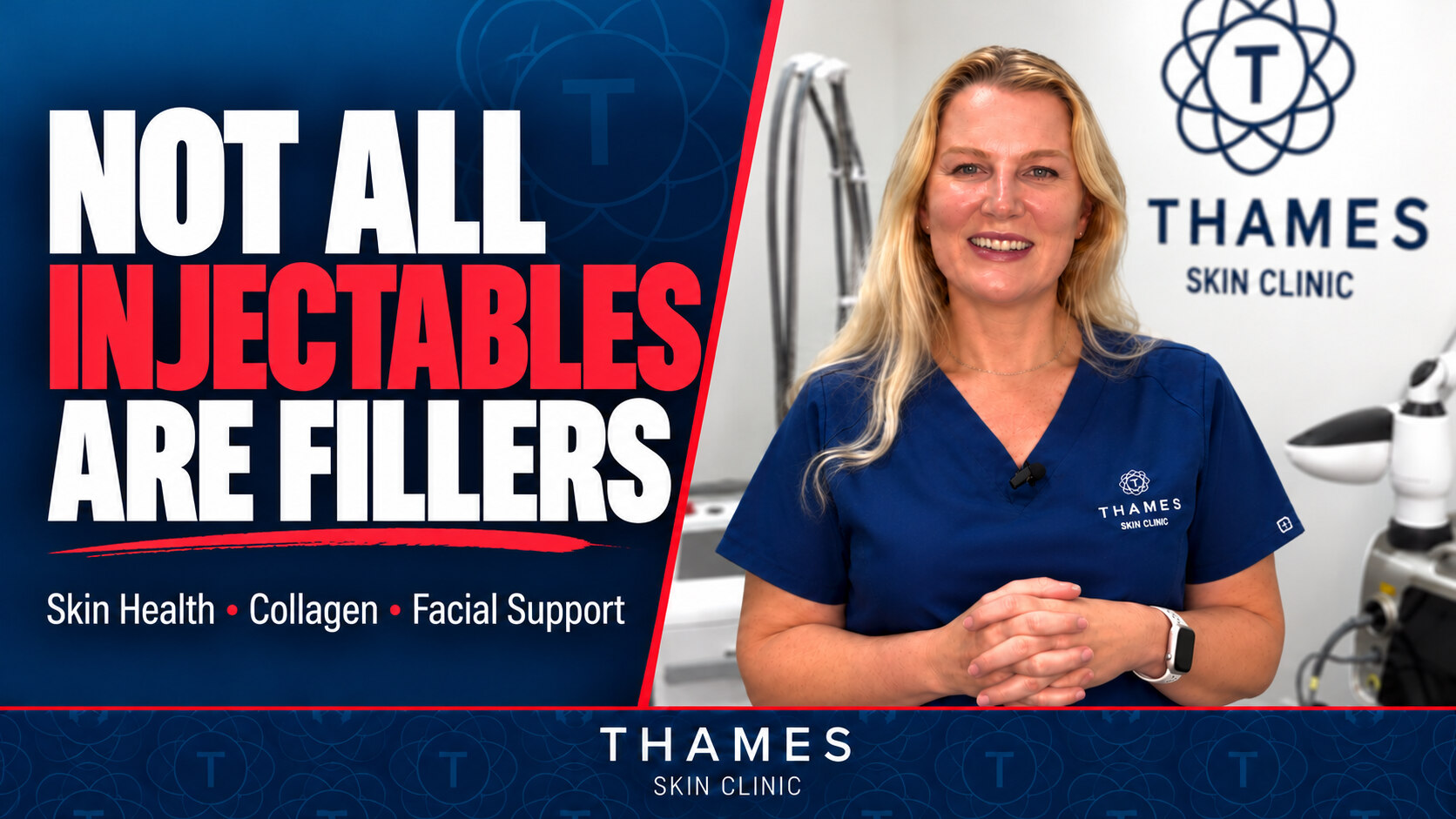
Watch Injectables Explained with Dr Anna Hemming
In the opening video, I explain the roles of fillers, Profhilo and skin quality treatments and why the whole face matters when planning injectables.
Watch Injectables Explained on YouTube
How we plan for natural-looking results
When I assess a fold beside the mouth, I look at the skin over it, how the cheek supports it and what happens when you smile. If the fold sits within skin that has become finer and drier, adding volume into the line may do little for the texture. If the cheek has changed shape, I consider whether a small amount of support elsewhere would improve the balance of the face. The assessment can also show that skincare, another procedure or time to observe the change would be more appropriate.
I use the same thinking when someone asks about a softer jawline. Skin laxity, fat distribution and changes in chin or cheek support can all contribute. Knowing which of those is most relevant helps avoid adding fullness to an area where that would make the face feel heavier. An exceptional result should look like it belongs to your face, even when you smile or speak.
I qualified as a doctor in 2002 and began practising aesthetic medicine in 2008. My work in injectables has been recognised by peers across the profession. Read more about my medical and aesthetic background.
- Best Injectable Result, The Aesthetics Awards 2025. Award organiser
- Aesthetic Practitioner of the Year – Doctor, Aesthetic Medicine Awards 2025. Award organiser
- Medical Aesthetic Practitioner of the Year, The Aesthetics Awards 2026. Award organiser
- Best Clinic South, Safety in Beauty Awards 2024, and Clinic Team of the Year, Aesthetic Medicine Awards 2024, for Thames Skin Clinic. Clinic awards · Aesthetic Medicine Awards
Those awards recognise the quality of individual work and of the team behind it. In a consultation, what matters to you is how we apply that experience to your face, your medical history and the result you want.
What are the main types of aesthetic injectables?
The table groups treatments by their main purpose. Placement and suitability depend on the individual product, the treatment area and the clinical assessment.
| Treatment group | Main purpose | Examples and how changes develop |
|---|---|---|
| Skin boosters | Hydration and selected skin quality concerns | Profhilo, Sunekos and other formulations. Changes are assessed over time. |
| Polynucleotides | Selected concerns about thin or crepey skin | Product-specific preparations. Evidence and treatment plans vary. |
| Collagen biostimulators | Encourage a gradual collagen response | Juläine contains poly-L-lactic acid (PLLA). Assess the response after the early swelling has settled and over the planned review period. |
| Collagen-stimulating fillers | Initial correction with a gradual collagen response | Ellansé contains polycaprolactone (PCL) microspheres in a carrier gel. |
| Superficial soft-tissue support | Selected cheek contour changes involving superficial fat | Profhilo Structura has a different formulation and intended placement from Profhilo. |
| Hyaluronic acid dermal fillers | Restore selected volume, shape or projection | Formulations differ by area and purpose. Early contour can change as swelling settles. |
| Treatments made from your own blood | Selected skin quality or soft-tissue goals, depending on preparation | Platelet-rich plasma (PRP) and Cellenis PRP Dermal Filler are prepared differently. |
Skin quality and hydration
Profhilo is a hyaluronic acid injectable used mainly for skin quality and selected laxity concerns. Someone with fine crepiness may want an improvement in how the skin looks and feels. A structural filler chosen to change cheek projection has a different purpose. Profhilo at Thames Skin Clinic.
Sunekos combines non-cross-linked hyaluronic acid and amino acids. Its 1200 and Performa formulations have different roles. I consider the formulation, the skin and the treatment area when discussing whether a course is appropriate. The phrase skin booster covers several formulations, so expected results and recovery vary. [1]
Polynucleotides are another option for selected skin quality concerns. Small clinical studies have explored their use around the eyes, although results from one formulation or area do not establish how every product performs. For under-eyes, I distinguish fine crepiness from a hollow, puffiness or pigmentation. Each can create a tired appearance and may need a different approach. [2] Polynucleotides at Thames Skin Clinic.
Collagen response and facial support
Juläine is a PLLA injectable designed to stimulate collagen production. The change we are looking for develops gradually. Fluid used in treatment and early swelling can affect what you see initially. [3] Juläine at Thames Skin Clinic.
Ellansé is a collagen-stimulating filler. Its carboxymethylcellulose gel gives initial correction, and its PCL microspheres are intended to encourage collagen formation over time. The enzyme used to break down hyaluronic acid filler cannot dissolve PLLA or PCL. I explain what that difference means for product choice, follow-up and the options if an outcome needs attention. [4] Ellansé at Thames Skin Clinic.
Profhilo Structura is designed for selected changes involving superficial facial fat. A pilot study looked at its use in the lateral cheek fat compartment. The treatment role is specific, and an assessment of the tissues is particularly useful when someone asks about loss of cheek support or a softer jawline. Significant excess skin may need a different assessment, including a surgical opinion. [5] Profhilo Structura at Thames Skin Clinic.
Volume, contour and proportion
Hyaluronic acid dermal fillers can change the shape or projection of a selected area. A gel used to restore cheek support may have different properties from one selected for the lips. I assess proportions from different angles, review any previous filler and consider how the face moves. An initial change can be visible straight away, with swelling sometimes altering how it looks. A review helps us decide whether further treatment would serve a purpose. Dermal fillers at Thames Skin Clinic.
Treatments made from your own blood
PRP is prepared from a sample of your blood to concentrate platelets. Studies of facial skin quality use different preparation and treatment methods, and reviews have found limitations in the evidence. Cellenis PRP Dermal Filler uses processed components of your blood to create an injectable preparation for selected soft-tissue goals. Suitability and risks depend on your health and the proposed procedure. [6, 7] PRP Dermal Filler at Thames Skin Clinic.
How to choose an injectable treatment and practitioner
Bring the concern that prompted your appointment and, if available, records of any previous treatments. A useful consultation should give you enough information to decide whether to proceed and time to consider the options.
- Check the practitioner’s credentials. Ask about professional registration, training in the specific treatment and experience in the area you are considering. Ask who will manage a complication and how you will reach them outside clinic hours. NHS advice on choosing a cosmetic procedure.
- Ask for the product name and the reason for using it. It should be traceable and recorded in your notes. Discuss how the product behaves, when results can be judged and what correction options exist.
- Discuss alternatives and the cost of the whole plan. Ask what is included in the assessment, treatment and review. If the result you want calls for a different approach, your clinician should be able to explain why.
- Agree how you will assess the result. A specific goal, such as restoring a little cheek support while preserving your proportions, gives the review a purpose. Adding more product is a separate decision.
Risks, recovery and when to get help
Bruising, swelling, redness and tenderness can occur after injections. Complications can include infection, persistent swelling, nodules, inflammatory reactions and an outcome that is difficult to correct. The risks differ by product and area. With dermal fillers, a rare but serious complication is blockage of a blood vessel. It can cause skin injury, vision loss or stroke. [8]
After filler, call 999 for sudden changes in vision or stroke symptoms. Severe or increasing pain and unusual pale, grey or mottled skin need immediate assessment. Contact your treating clinic urgently and seek urgent medical help if you cannot reach them. Know how to contact the clinic before you go ahead. [8, 9]
Why skin health is part of every plan
I look at the condition of the skin before deciding whether an injectable has a role. Dryness, redness, pigmentation and rough texture can all change how the face looks. A plan for those concerns may include daily sun protection, a personalised skincare routine, laser or another skin treatment. At Thames Skin Clinic we use ZO Skin Health where appropriate and tailor the routine to your skin, tolerance and treatment timetable.
Some people benefit from a staged plan. Treating one concern and reviewing it before adding another makes it easier to see what helped. For someone with thin skin and reduced cheek support, that may mean discussing two different goals over separate appointments. The aim is an improvement you can see while retaining the features and expressions that make your face yours.
Your consultation at Thames Skin Clinic
The THAMES philosophy guides how we assess, plan and review care.
- Thorough. We discuss your health, medications, previous procedures and goals.
- Holistic. We consider skin health, movement and facial support together.
- Assessment. We examine the tissues that contribute to the concern.
- Medical. We discuss suitable options, evidence, alternatives and consent.
- Expectations. We explain likely benefits, recovery, limits, cost and when to review.
- Safety. We consider suitability, product traceability, aftercare and how you can reach us if you need help.
Thames Skin Clinic is a doctor-led medical skin clinic at 1–3 Baylis Mews, Twickenham TW1 3HQ. We see patients from Richmond, St Margarets, Teddington, and across South West London. The clinic is registered with the Care Quality Commission for its listed regulated activities. CQC registration details.
A new-patient consultation with me is £249. It includes a skin scan, a review of your medical history, previous treatments and goals, and a personalised treatment and skincare plan. We recommend a new-patient consultation or a full assessment for existing patients before starting an injectable plan.
If you’re returning for a treatment you’ve had with us before, you may be able to book a treatment appointment directly. At the appointment, we review any changes in your health or treatment history, check that the treatment is still suitable and ask for your consent before proceeding. You can book a separate full consultation for a wider assessment or to discuss a new treatment plan.
Frequently asked questions
Are all injectables dermal fillers?
No. An injectable is a product delivered by injection. Some are used for skin quality, some are designed to stimulate a collagen response and others are selected to restore contour or volume. Ellansé is an example of a filler with a collagen-stimulating role.
What is the difference between Profhilo and Profhilo Structura?
Profhilo is used primarily for skin quality. Profhilo Structura is formulated for selected superficial facial fat changes. The choice depends on the tissue being assessed and the purpose of treatment.
What is Sunekos and is it a filler?
Sunekos is a skin booster that combines non-cross-linked hyaluronic acid with amino acids the skin uses to build collagen and elastin. It is not a volumising filler. Sunekos 1200 and Sunekos Performa have different roles, and treatment is usually planned as a course, with changes assessed gradually. [1]
Can fillers make me look natural?
Filler can be used to make a subtle change when the concern involves volume or contour. The amount, placement and product should suit your features and movement. A review gives you time to see how the change has settled before deciding whether to do more.
Can all injectables be reversed?
An enzyme can break down hyaluronic acid filler in suitable circumstances. It cannot dissolve products such as Juläine or Ellansé. Any plan for correction should begin by identifying the product and the cause of the concern.
When will I see a result and how long will it last?
An initial contour change can be visible after filler. Your clinician will explain when to judge it once swelling settles. With collagen biostimulators, the change is gradual and assessed over a longer period. Longevity varies with the product, area treated and individual response. A review can help you decide whether any maintenance would be useful.
Which injectable will help jowls or tired-looking under-eyes?
That depends on the cause. Jowls can involve loose skin, changes in facial fat and reduced support. An under-eye shadow can be caused by hollowing, pigment, swelling or thin skin. I assess the whole area, including cheek support, before considering treatment.
Where can I have an injectable consultation near Richmond?
I see patients at Thames Skin Clinic in Twickenham, at 1–3 Baylis Mews, TW1 3HQ. A consultation gives us time to assess your skin and anatomy, discuss your goals and explain the options. Call 020 8150 3400 or book a consultation with Thames Skin Clinic.
Continue the Injectables Explained series
This is the opening article in our Injectables Explained series. Later articles cover how treatments work in different facial tissues, what to check before choosing a practitioner, specific areas such as the cheeks and under-eyes, and how to review results over time. Explore our Injectable Treatments Guide for the clinic’s treatment pages or arrange an individual consultation if you would like advice on your own concerns.
This guide is for general education. An individual consultation is needed to assess suitability, benefits, risks and alternatives.
References
- AestheticSource SuneKOS UK product information.
- Lee et al. Polynucleotides and hyaluronic acid in a randomised split-face periocular study.
- Nordberg Medical Juläine product information.
- Ellansé manufacturer information on the gel and PCL microspheres.
- Profhilo Structura observational pilot study of the lateral cheek fat compartment.
- Cruciani et al. Overview of systematic reviews on PRP for facial rejuvenation.
- Cellenis DermaFiller manufacturer information.
- US FDA dermal filler safety information.
- NHS symptoms of stroke and emergency advice.